


DeepProve is now open source
June 3, 2026
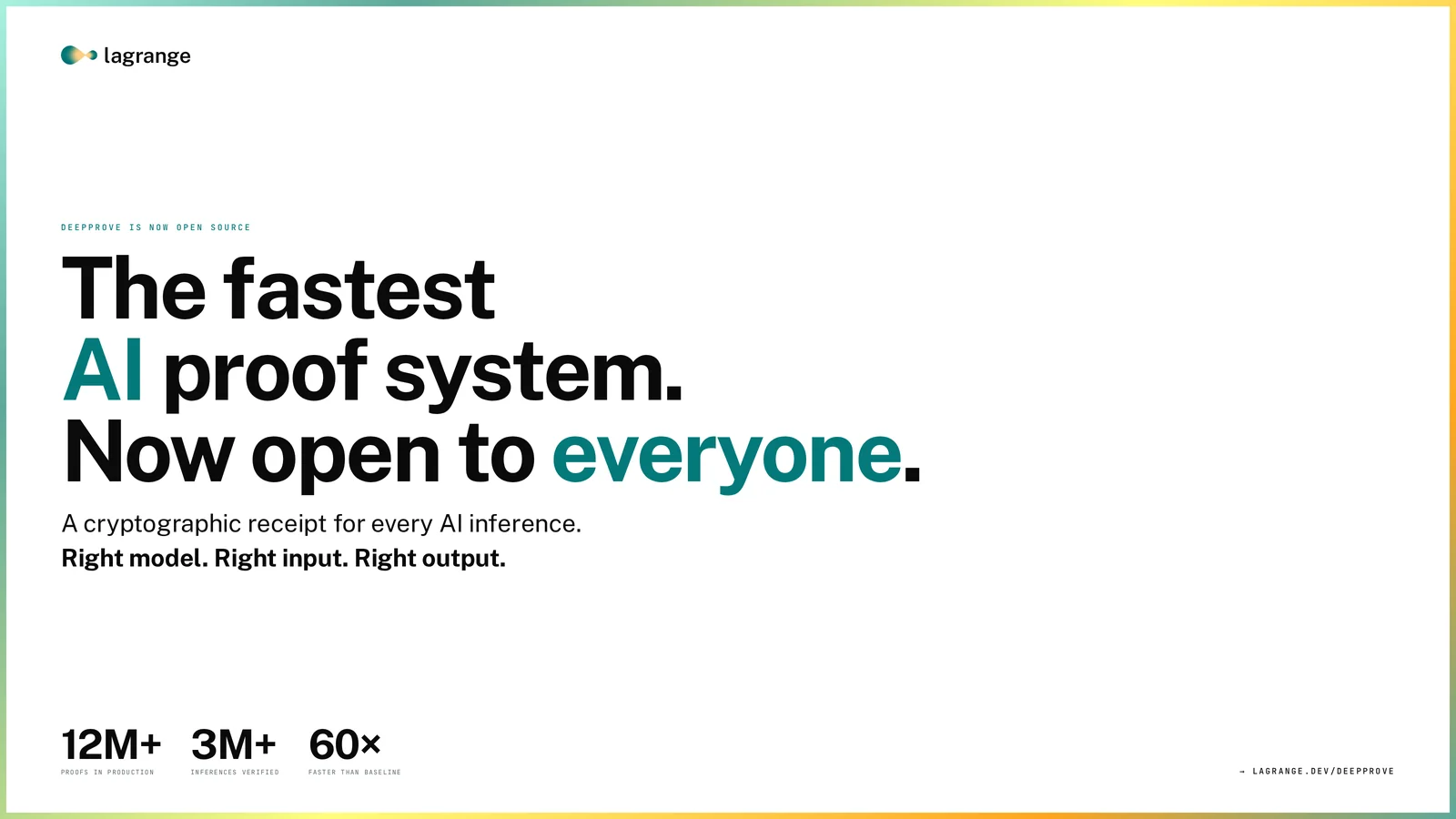
The fastest AI proof system in production is now yours to fork, run, break, and build on.
→ Fork the repo · View live proofs
Three years ago we set out to make AI verifiable. Not in a paper. Not as a future roadmap. In production.
Today, the DeepProve stack is now open source and available to everyone. The repo is live. The dashboard is public. The methodology is published.
What we just open-sourced
DeepProve is a zero-knowledge machine-learning system that creates a cryptographic proof for an AI inference. In plain English: it gives you a receipt.
A receipt that says the right model ran on the right input and produced the output you're looking at. The verifier can check that proof in milliseconds, without needing access to private model weights or input data. You can verify it on-chain.

Inside the repo:
- The full proving stack: circuits, prover, verifier
- ONNX, safetensors, and GGUF support, so you can bring models from PyTorch, TensorFlow, JAX, or Hugging Face. No other zkML library supports the formats LLMs actually ship in
- Reproducible, layer-by-layer benchmarks. LLM proofs up to 60x faster than the prior state-of-the-art, with 671x faster verification. Unlike competitors, DeepProve preserves model accuracy
- Working examples across GPT-2, Gemma-3, classifiers, and vision models
- A paper documenting the methodology behind the LLM proof speedup and the accuracy-preservation result
Why now
Because AI is moving from demos into systems that actually matter.
Agents are taking actions. Models are making recommendations. AI is being pushed into finance, defense, healthcare, enterprise workflows, and infrastructure.
And the question is no longer just:
"Did the AI give a good answer?"
The better question is:
"Can you prove what actually happened?"
DeepProve does not magically make every answer true. That is not the claim. What it does is give builders, users, auditors, and systems a way to verify that an inference was executed correctly.
That matters because the world is asking for more than AI confidence scores.

Stanford's 2026 AI Index reported 362 documented AI incidents in 2025, up from 233 the year before. Regulators are moving in the same direction. The EU AI Act requires high-risk AI systems to support logging, traceability, documentation, oversight, robustness, and accuracy.
The direction is clear: AI systems need evidence.
We think that evidence should be cryptographic proof, not simply brand trust.
What it has already done
DeepProve is not starting from zero.
Over the last year, it has produced:
- 12+_ million cryptographic proofs in production
- 3+ million AI inferences verified end-to-end
- Working with partners including Anduril, Oracle, Intel, NVIDIA, and IBM
- 200+ crypto and enterprise integrations across the Lagrange network
- The proof layer behind Turing Roulette, where 50k unique players generated over 3.7M live AI inferences
The dashboard you can view today is the same kind of live visibility we use internally.
Real proofs. Real workloads. Running now.
The technical claim, plainly
DeepProve generates LLM inference proofs up to 60x faster than the prior zkML state-of-the-art, with 671x faster verification. And critically, DeepProve preserves model accuracy. Competitors don't.
It is the first production-ready zkML system we know of to prove full LLM inferences end-to-end, including GPT-2 and Gemma-3, with Llama-class models in active development.
And it works the way developers expect: bring an ONNX, safetensors, or GGUF model, run it through DeepProve, generate a proof, verify the result.
No proprietary workflow. No closed proving box. No "trust us, it works."
Now you can check.
What we want you to do with it
Fork it.
Run it.
Break it.
We've spent years building the prover, but open source will test it in ways no internal team ever could. Different models. Weird workloads. New edge cases. Things we haven't thought of yet.
That is the point.
If you're building agentic infrastructure, DeepProve gives you the missing receipt: proof that the model was the model, and the output was the output.
If you're working in a regulated environment, it gives you something concrete to attach to an AI decision.
If you're a researcher, it gives you a production-grade system to inspect, challenge, and improve.
The bigger move
We didn't build DeepProve so verifiable AI could belong to us.
We built it because AI needs a verification layer, and that layer should be open.
Today, the black box is open.


