


Introducing Lagrange Halo
June 24, 2026

Drones, robots, and uncrewed vessels that have to act as a group share one weakness: staying in agreement when the network breaks. Lagrange Halo is the layer that holds them together.
→ Run a scenario · See it work · Read the technical FAQ
Ukraine’s defense industry can now build more than 8 million FPV drones a year. Russia is planning for more than 7 million in 2026. Along a front line that runs more than a thousand kilometers, both sides are fighting inside what’s been called the densest electronic-warfare environment in modern history — a place where the radio signals drones depend on are routinely jammed, spoofed, or drowned out.
The autonomous-systems era didn’t sneak up on anyone. It arrived at industrial scale, in exactly the conditions that break almost every system we have.
Today we’re launching Halo — the coordination engine that keeps those systems working when the environment itself stops cooperating.

What it is
Drones, robots, uncrewed vessels — anything that has to act as a group — share a single dependency. They have to keep agreeing on what’s true, even when communications degrade, individual platforms drop offline, and the network underneath them fragments.
Halo is the layer that makes that agreement hold. In plain terms: it ensures a coherent understanding of the situation for the whole group, even when platforms lose communications.
Every node sees the same operational picture. Failures get detected without false alarms. Work gets reassigned the second a drone disappears. The system reconfigures itself in real time, without anyone — in the air or on the ground — telling it to.
No central controller. No single point of failure. No mission-software rewrite required.
It runs underneath whatever autonomy stack a team is already operating. It is, deliberately, a layer we don’t believe anyone has shipped before.
Why now
Because the constraint on autonomous systems is no longer the platforms themselves. It’s the connective tissue between them.
The Pentagon set out to field thousands of autonomous systems under the Replicator initiative. By its original August 2025 milestone, the public tally was in the hundreds. Senators have called the $54.6 billion drone budget a strategy without a doctrine. The Center for a New American Security has named interoperability — getting drones, robots, and other uncrewed platforms from different vendors and services to work together — as the missing layer.

The Air Force is putting $804.4 million into Collaborative Combat Aircraft in fiscal 2026, with more than a hundred uncrewed teammates planned in its first phase alone. The service has been explicit about what those aircraft will have to do once they’re flying alongside crewed fighters: read their own situation, handle sensor fusion and threat prioritization, and make maneuver decisions with limited human oversight. In other words, a whole group of uncrewed aircraft has to figure out who’s doing what and respond in seconds — without a human in the cockpit, and often without a clean line back to one. That’s a coordination problem. It is not a drone problem.
Every autonomy vendor today has rebuilt some version of this coordination logic — inside its own vertical stack, one mission at a time, on top of platform-specific assumptions that don’t survive contact with a jammed front line.
No one we know of has shipped the connective layer that lets them stop rebuilding it.
How it works
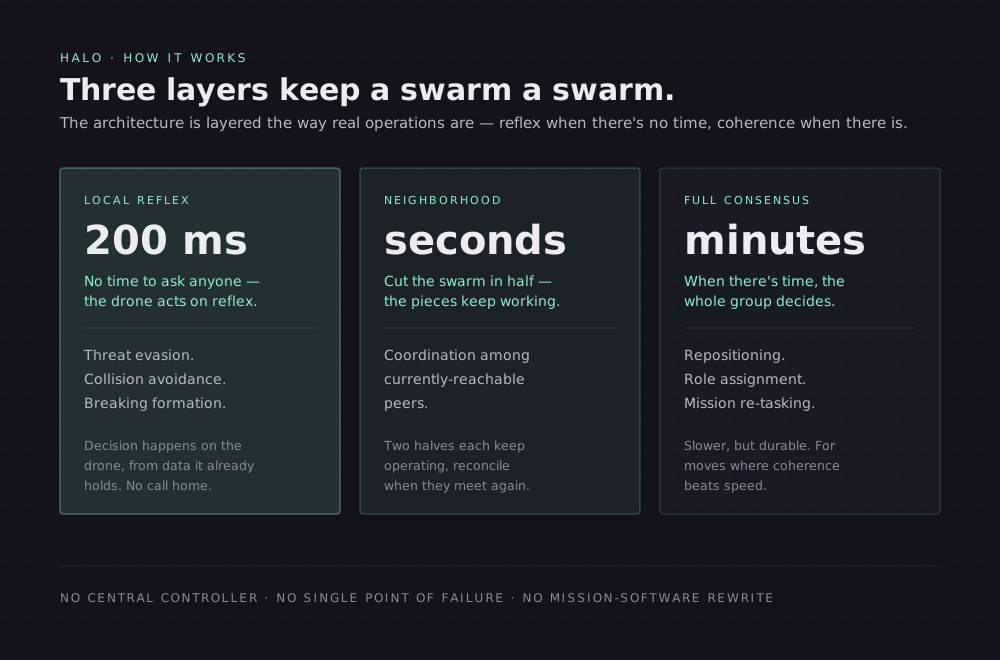
The architecture is layered the way real operations are.
When there’s time, the whole group decides together. Repositioning, role assignment, anything that needs everyone to agree goes through full consensus across the network — slower, but durable, for the moves where coherence matters more than speed.
When the swarm gets cut in half, the pieces keep working on their own. Inside the nodes a drone can still reach, coordination continues without waiting on the rest of the group. Two halves of a split swarm each keep operating, and reconcile when they find each other again.
And when something happens in 200 milliseconds, the drone acts on reflex. Every drone holds its most recent picture locally, so when a threat appears and there’s no time to ask anyone, the decision happens on the drone, with the data it already has, without calling home.
Together, those three layers are how a swarm stays a swarm while the network is breaking.
Underneath, Halo runs on a shared-state protocol that’s authenticated, keeps everyone’s updates in the right order, and tolerates patchy connectivity. Its failure detector is built for partial-comms environments — not a naive timeout — so the system doesn’t declare live drones dead and thrash roles. And recovery is cooperative: every surviving node reaches the same conclusion, because they’re all working from the same picture.
What ships at launch:
- The core engine
- Four reference coordination modes — collaborative sensing and ISR, communications relay, resilient formation and area coverage, and task reassignment and asset-loss recovery
- Developer interfaces that drop into the autonomy stacks teams already run, without forcing a rewrite
- A live, browser-based sandbox where you can drop assets onto a map, inject failure, and watch the system hold its shape
The whole thing runs at the edge on the platform, off-platform on a ground station, or hybrid — the way real operators actually deploy.
Why Lagrange
Lagrange is a team of distributed-systems engineers and cryptographers who’ve spent their careers on one problem: how systems agree on what’s true under adversarial conditions.
When we looked at autonomous systems, we saw the same patterns we’d seen for years in every other distributed system that has to keep working when it can’t trust its environment. We watched the industry rebuild the same coordination logic from scratch on every program. We saw a market that was crowded at the platform level and empty underneath it.
Halo isn’t a research artifact. It’s a library a working team can drop into the stack they’re already running — no new runtime to adopt, no core software to replace. Built for the conditions you can watch on the news any night of the week.
What’s next
The launch is the start.
Over the next six months we move from simulation into the field: fifty-node trials, published scorecards under real electronic-warfare pressure and GPS denial, and reference-platform work with the drone makers already shipping into Replicator. After that — ground, maritime, and the crewed-uncrewed teaming the next generation of defense programs is built around.
The architecture isn’t drone-specific. Drones are just where the pressure is highest today. The same engine maps onto any distributed autonomous system that has to operate in conditions worse than the lab.
The bigger thing we’re building toward is what we call verifiable autonomy — coordinated action that people can trust, audit, and hold accountable in the conditions it actually runs in. It’s where Halo meets the proof work Lagrange is known for. Halo is the first piece.
If you’re building, integrating, or buying autonomous systems — if the part of your stack that breaks first under real conditions is the part Halo is built to own — we’d like to hear from you.
Autonomous systems don’t fail in the lab. They fail in the real world. Halo is what keeps them flying when they do.
A system that keeps thinking when everything around it is trying to make it stop.
→ Book a brief · Read the roadmap · Run a scenario
Sources: Ukraine FPV production capacity — National Security and Defense Council of Ukraine, 2026 (annual capacity figure, not 2025 output). Russia 2026 FPV plan — Ukrainian Armed Forces Commander-in-Chief Oleksandr Syrskyi, reported by Bloomberg and Kyiv Post, 2026. Electronic-warfare environment — as characterized in defense and open-source reporting, 2025–2026. Replicator program status — Congressional Research Service, 2026. Senate critique of the drone budget — Senate Subcommittee on Emerging Threats and Capabilities, May 2026. Interoperability as the missing layer — Center for a New American Security. Collaborative Combat Aircraft funding and autonomy requirements — Congressional Research Service and U.S. Air Force descriptions reported by Defense.info and Military Times, 2026.


